
What to Do When You Have Water in Your Basement After Heavy Rain
Coming downstairs to water in your basement after a big Niagara storm is one of the worst surprises a home can hand you. Maybe the sump pump was struggling, maybe you stepped onto a soaked carpet, maybe the water is still rising while you read this. Whatever brought you here, take a breath. It is stressful, it happens to plenty of homes across St. Catharines and the region, and it can be handled safely in the right order.
This guide covers what to do first, why basements flood, whether your furnace and water heater are safe to run again, and how to keep the next storm from doing the same thing. We have kept Niagara homes comfortable since 1978, and because we handle both HVAC and plumbing, we can look at the flooded equipment and help stop the water at its source.
First steps if your basement is flooding right now
- Stay out of the standing water until the power is off, especially near outlets, baseboard heaters, the furnace, or the electrical panel.
- Shut off the power only if the panel is dry and you can reach it safely. If not, call your electricity utility to disconnect it.
- Do not relight any gas appliance that has been in water. Leave it off and call Mr. Furnace at (905) 346-3507 for a licensed inspection first. Let us know when you book an appointment that you’ve recently experienced a flood and we can take it from there!
- Take photos and video of all the damage before you move or clean anything.
- Once power and gas are confirmed safe, start removing the standing water and drying the space.
- Call your insurer, and call us to assess both the source and the equipment.
First, Stay Safe: What to Do Right Now
The instinct is to grab a bucket and start bailing. Hold off. Floodwater and electricity are a dangerous mix, and the first few minutes are about staying safe, not cleaning up.
Stay out of standing water until the power is off
The Electrical Safety Authority says it plainly: water and electricity do not mix. Electricity moves through water and wet flooring, and a shock can be serious. Do not step into the basement if the water is above your outlets, touching baseboard heaters or the furnace, or anywhere near the electrical panel. Standing water can carry a live charge even when everything looks perfectly normal.
Shut off the power only if the panel is dry and reachable
If your electrical panel is dry, easy to reach, and you can get to it without stepping in water, switch off the power. If any part of that is in doubt, leave it and call your electricity utility to cut power to your home. After a flood, have a Licensed Electrical Contractor check the system before power goes back on, and ask for the ESA Certificate of Acceptance for your records and your insurer. Electrical work is outside what we do, so line that call up separately.
Do not relight gas appliances, and leave if you smell gas
A gas appliance that has been sitting in floodwater is not safe to simply switch back on. Submerged gas equipment may not work safely and needs a licensed inspection before it is used again. That is exactly the inspection we do: leave the unit off, call Mr. Furnace, and one of our licensed technicians will check your furnace, water heater, or AC before it runs. And if you smell gas, or see a gas line that is broken or exposed, get everyone out of the home right away and call the gas company from somewhere safe.
Photograph everything, then call for help
Before you move a single box or run a fan, document the damage: photos and video of the water line, the affected rooms, and your belongings. Insurers want proof before they approve a claim, and it is easy to capture now and impossible to recreate later. After that, the water still has to come out and the source still has to be found. A flooded basement is rarely a one-trade job, and we answer around the clock.
Do / Don’t in the first hour
| Do | Don’t |
|---|---|
| Keep people and pets out of the standing water | Wade in to grab belongings before the power is off |
| Cut power at a dry, reachable panel, or call the utility | Touch a wet panel or a submerged outlet |
| Photograph all the damage before cleanup | Start hauling things out before you document it |
| Leave any flooded gas appliance off and call for a licensed inspection | Relight the furnace or water heater yourself |
| Wear rubber boots, gloves, and a mask near the water | Assume the water is clean |
Why Is My Basement Flooding After Heavy Rain?
Figuring out where the water is coming from tells you who can fix it and how to keep it from coming back. After a heavy Niagara storm like the ones we experienced all summer in 2026 a few causes are far more common than the rest.
Sewer backup and surcharge is the most common storm-driven cause around here. When heavy rain overwhelms the municipal sewer, water rises above your basement floor level and pushes back up through floor drains, toilets, or laundry connections. It is also the messiest, because that water is not clean.
A blocked or failed sewer lateral is a close second. The pipe carrying wastewater to the municipal sewer can get choked by tree roots or break down with age. Our drainage service team can run a camera down the line to find the blockage.
Foundation cracks and seepage show up when saturated ground presses on the foundation and water finds its way through cracks, gaps around pipes, and porous concrete.
A failed or overwhelmed sump pump is another frequent culprit. If it quits, loses power, or cannot keep up, the water it was holding back ends up on your floor.
Window wells, grading, and downspouts send water the wrong way, filling and leaking, sloping rain back toward the walls, or dumping roof runoff beside the foundation.
Where the water is coming in, and who handles it
| Where you see the water | Most likely cause | Trade that handles it |
|---|---|---|
| Up through floor drains or the toilet | Sewer backup or surcharge, or a blocked lateral | Drainage / plumbing |
| Through foundation wall or floor cracks | Seepage under ground pressure | Waterproofing specialist |
| Around the sump pit, or the pump ran and quit | Failed, overwhelmed, or power-lost sump pump | Plumbing |
| Below a basement window | Leaking or overflowing window well | Waterproofing / grading |
| A wall that is wet after every storm | Grading or downspouts sending water at the foundation | Waterproofing / exterior drainage |
Is Your Furnace or Water Heater Safe After a Flood?
This is the part most flood articles skip, and it matters most for your safety. Restoration crews dry the room. They do not inspect the gas-fired equipment sitting in the middle of it. That is where we come in.
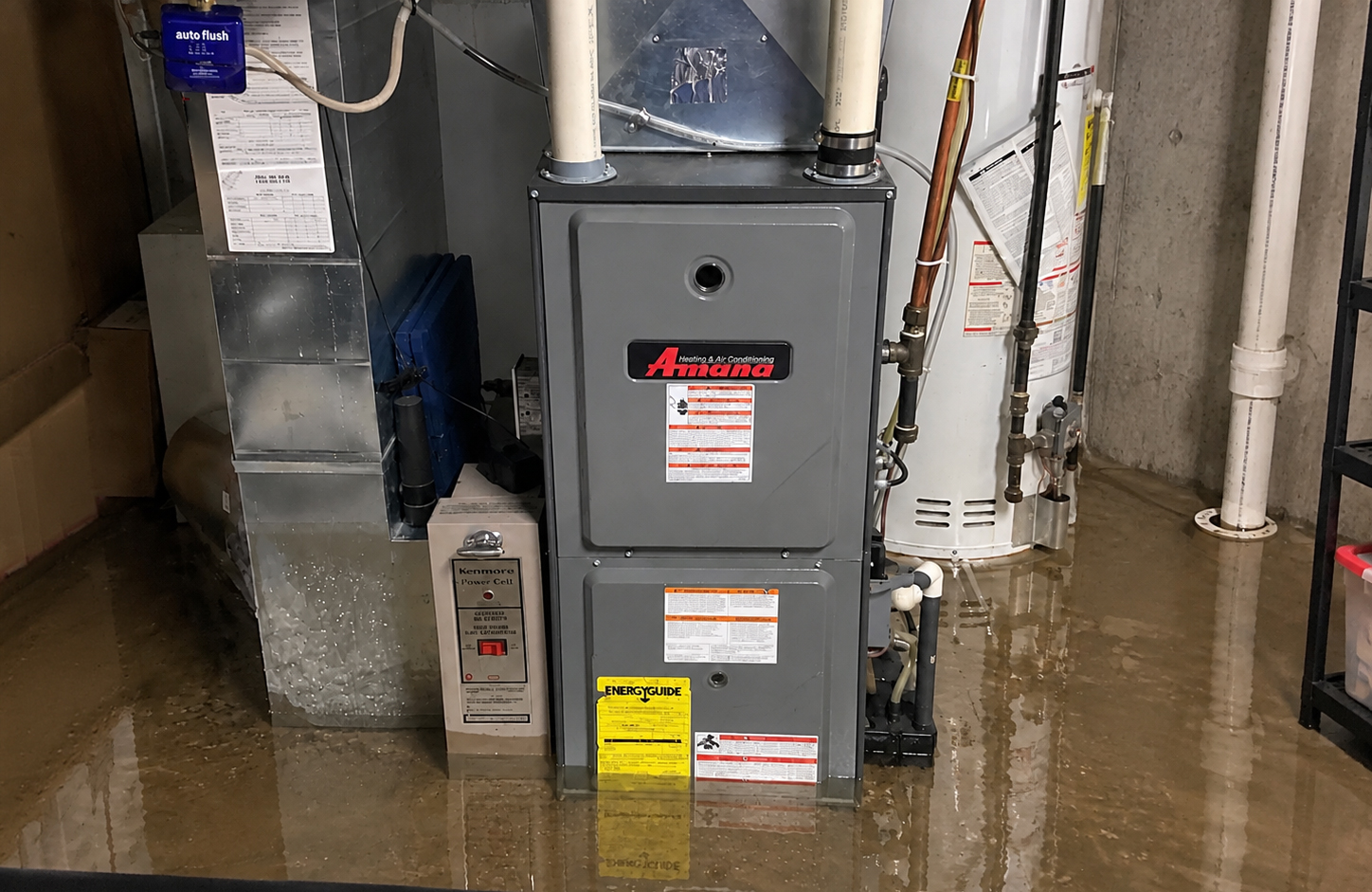
Do not restart a furnace that has been in floodwater. If your furnace has been standing in water, or water reached its base, leave it off. It can look completely fine and still be unsafe. Gas appliances in Ontario fall under the Technical Standards and Safety Authority, and only a licensed gas technician (G1 or G2) may work on the gas components. That unit needs a licensed inspection before it is powered or gassed back on. This is standard work for a Mr. Furnace technician
Why flooded equipment is dangerous: floodwater carries silt, sewage, and corrosive material into the parts you cannot see. A submerged gas control valve can fail in the open position, which means gas keeps flowing when it should shut off. Silt and corrosion chew up burners, ignition controls, circuit boards, and safety sensors, and insulation that soaks up contaminated water cannot be cleaned and has to be replaced. A compromised valve, burner, or vent raises the risk of both a gas leak and carbon monoxide.
Safety callout: Never try to restart, relight, or dry out flooded gas or electrical equipment yourself. A furnace, water heater, or air conditioner that has been in floodwater needs a licensed technician to inspect it before it is powered or gassed back on. There is no shortcut here, and there is no charge for asking.
Water heaters are especially vulnerable. Once floodwater reaches the burner and controls of a gas water heater, replacement is usually the safe call rather than repair, because the controls and insulation that keep it running safely cannot be reliably restored after a soaking.
Repair or replace? As a general industry standard any flooded furnace, water heater, or AC needs a licensed inspection before it runs, and flooded gas-fired equipment often turns out to be a replacement, not a repair. A good technician walks you through which one you are looking at, and why.
How to Stop It From Happening Again
Once the emergency is behind you, the goal is making the next big storm a non-event. The right fix depends on how the water got in, which is why the diagnostic above matters.
Sump pumps and battery backups. A sump pump is your frontline defence against groundwater, collecting the water around your foundation and pumping it away before it reaches the floor. Here is the catch: the storms that make a sump pump most necessary are the same ones most likely to knock out your power, and a standard pump stops the second the power does. A battery backup keeps it running through an outage and covers you if the main pump gets swamped. Our plumbing team can size and install both.
Backwater (backflow) valves. A backwater valve installs on your sewer lateral and closes on its own when water tries to flow back toward the house. When the municipal sewer surcharges during a storm, the valve shuts and keeps sewage out of your basement. Since sewer backup is the most common storm cause around here, this tackles the problem at its source. Our plumbing and drainage team installs these too.
Sump pump vs backwater valve: what each protects against
| Sump pump | Backwater valve | |
|---|---|---|
| Protects against | Groundwater rising around the foundation | Sewage backing up from the municipal sewer |
| Where it sits | In a pit in your basement floor | On your sewer lateral |
| When it works | Continuously, as groundwater collects | Automatically, when the sewer surcharges |
| Needs power? | Yes (add a battery backup) | No, it is mechanical |
| Common failure | Power loss or too much volume | Debris holding the flap open (needs maintenance) |
They solve two different problems, which is why a lot of Niagara homes end up with both. One is not a stand-in for the other. Waterproofing, downspouts, and grading. If water is coming through the foundation itself, waterproofing is the fix: sealing cracks, improving the weeping tile, or interior or exterior work depending on the home. That is specialized foundation work for a waterproofing specialist, not something we take on. Some of the most effective prevention, though, is also the cheapest, and you can do a fair bit yourself: extend your downspouts so roof water lets out well away from the foundation, regrade soil that slopes back toward the house, and keep your eavestroughs and drains clear. Little things like that keep a small problem from becoming the next flood.
Does Home Insurance Cover Basement Flooding in Ontario?
This is general information, not advice, and the only reliable answer is the one in your own policy. Here is the part a lot of homeowners miss until it is too late.
A standard home insurance policy in Canada does not automatically cover basement flooding. According to the Insurance Bureau of Canada, that protection usually comes from two separate optional add-ons. Sewer backup coverage handles damage from sewer or septic backup. Overland water coverage handles surface water from heavy rain, overflowing rivers or lakes, and fast snowmelt. Both often come with limits, and overland coverage can be restricted in higher-risk areas.
The trap is assuming you are already covered, when plenty of homeowners find out only after a flood that they had neither add-on. It is worth a five-minute call to your insurer or broker to confirm what you have, better before the next storm than after it. Whatever your coverage looks like, document the damage before you clean up. For context: water is now the leading cause of home insurance claims in Canada, ahead of both fire and theft, and severe weather is driving that trend, with insured damage in 2025 among the highest years on record.
When to Call Mr. Furnace
A flooded basement is one of those problems where the sooner someone looks at it, the less it ends up costing you. Water that sits keeps soaking into concrete, wood, and insulation, and mould gets going fast. If your basement has taken on water, have someone assess both the source and your equipment.
Give us a call when:
- Water reached your furnace, water heater, or AC and it needs a licensed inspection before anything runs again.
- Water is coming up through floor drains or the toilet, which points to sewer backup.
- The sump pump failed, ran dry, or could not keep up.
- You want to keep it from happening again with a backwater valve, a sump pump backup, or drainage work.
Because Mr. Furnace runs HVAC and plumbing together, one call covers both sides: the licensed inspection of your gas equipment and the plumbing that helps stop the next flood. We have done this across St. Catharines and the Niagara region since 1978, and we are here 24/7, same rate at 2 AM as 2 PM, no overtime charge. (Some electrical work and foundation waterproofing might be outside what we do, so we will point you to the right specialist for those if need be.)
Ready to get your basement sorted?
A flooded basement is a bad day. Getting it assessed, dried, and set up against the next storm is how you make sure it stays a one-time thing.
The Mr. Furnace team handles both sides of the job: the licensed inspection of your furnace, water heater, and AC, and the plumbing that keeps water out next time. Same steady help at 2 AM as at 2 PM, no overtime charge.
Or call us anytime: (905) 346-3507
The pros in the green trucks at Mr. Furnace have been serving St. Catharines, Niagara Falls, Welland, Thorold, Fort Erie, and the Niagara region with reliable HVAC & plumbing services since 1978. Available 24/7.
Frequently Asked Questions About Flooding In Your Basement
Why does my basement flood when it rains heavily?
The most common cause in the Niagara region is sewer backup, when heavy rain overwhelms the municipal sewer and water pushes up through your floor drains. Other frequent causes are foundation cracks and seepage, a failed or overwhelmed sump pump, and poor grading or downspouts sending rainwater toward your foundation.
What should I do first if my basement is flooding?
Stay out of the standing water until the power is off, because water and electricity are a dangerous mix. Shut off the power only if the panel is dry and reachable, otherwise call your utility. Do not relight gas appliances, photograph the damage, then call a professional.
Is it safe to use my furnace after it has been in a flood?
No, not until a licensed technician inspects it. Floodwater damages gas valves, burners, controls, and insulation in ways you cannot see, which raises the risk of a gas leak or carbon monoxide. A furnace that has been submerged is often a replacement rather than a repair. Never restart it yourself.
Do I need a sump pump and a backwater valve, or just one?
They protect against different problems, so many homes need both. A sump pump moves groundwater away from your foundation. A backwater valve stops sewage from backing up out of the municipal sewer during a storm. One does not replace the other, so the right answer depends on how water is getting into your basement.
Does home insurance cover basement flooding in Ontario?
Usually not automatically. A standard policy typically excludes it, and coverage comes from two optional add-ons: sewer backup and overland water. They cover different causes, both often carry limits, and many homeowners discover after a flood that they had neither. Check your specific policy with your insurer or broker.
Is standing water in a flooded basement dangerous?
Yes, for two reasons. It can carry a live electrical charge if it reaches outlets, wiring, or the panel, so stay out until the power is off. It can also contain sewage, chemicals, and pathogens, especially in a sewer backup. Keep contact to a minimum, and wear rubber boots, gloves, and a mask during cleanup.
How can I stop my basement from flooding again?
Match the fix to the cause. A backwater valve stops sewer backup, a sump pump with a battery backup handles groundwater, and waterproofing seals a leaking foundation. Extending downspouts, improving grading, and keeping drains clear help too.
How soon should I call a professional after a basement flood?
As soon as the immediate hazards are handled. The longer water sits, the deeper it works into concrete, wood, and insulation, and the faster mould grows. A quick assessment of both the water source and any flooded gas equipment limits the damage and keeps your home safe. The Mr. Furnace team is here 24/7.